Sunday, June 2, 2013

A Look at My Classroom

Now that school is out for the summer, I have some think to think back over the past year and evaluate my program.  I have begun to make plans for next fall.  So I thought I would give you a look at my students and tell you about what I did this year.

Reading Essentials Class is a reading intervention in our middle schools, grades 6-8.  The three classes each meet daily for 40 minutes.  Each session lasts for six weeks.  Because I am a part-time employee, we offer three sessions each school year.  The class has been set up this way because of funding.  There are enough students in our school of 350 students who would benefit from reading interventions to offer more sessions, but the school has not allocated money for that many days of staffing.

Each student usually attends one of the three sessions, although occasionally a student may repeat for a second time.  I had one student this year who attended all three sessions.  He has a several reading disability and his parents requested that he be included in each session.

Our classroom is less than ideal.  I have to use the computer lab because it is the only classroom available during my class time.  So my vision of a room with reading spots that allow students to get comfortable with pillows, lamps and overstuffed chairs had to be replaced with reality.

But my students are allowed to find a spot that is comfortable for them.  Here are some pictures of a typical class day.

Sue, shown below, has taken Reading Essentials as a 7th grader and again as an 8th grader.  When she began, she did not enjoy reading but has developed into quite a reader.  Her choice of Charlotte's Web seemed too easy for her.  However, she really enjoyed it and seemed happy every day to get in her spot.  


Sue is an 8th grader


 Each student meets for a conference 1 -2 times a week.  Here Jay meets with Chris who is my helper.  Actually she is very organized and I depend on her so much.  We don't use the computers in our conferences but simply push them back to give us desk space.  We use the CAFE menu to pick strategies to work on with the students.


Ann had some difficulties in school and liked to be out of sight when she was reading.  Actually she is sitting very close to Chris but the open door seems to give her a feeling of isolation.


Some students like to sit in the chairs.  You can see Lee's tub sitting on the table.  I follow many of the organize methods from the Daily Five book.


This student doesn't look comfortable to me but it is her choice.


Students are allowed to choose their own reading material.  I have a small classroom library.  They also use our school library.  Each Language Arts teachers has many books for the students too.  I have read The Book Whisper by Donalyn Miller and I've used this philosophy in my class too.  If you look closely, you can see this student is reading about basketball which was his passion.


Find a spot and get reading quickly is our classroom rule.  I use an I-Chart as detailed in Daily Five.

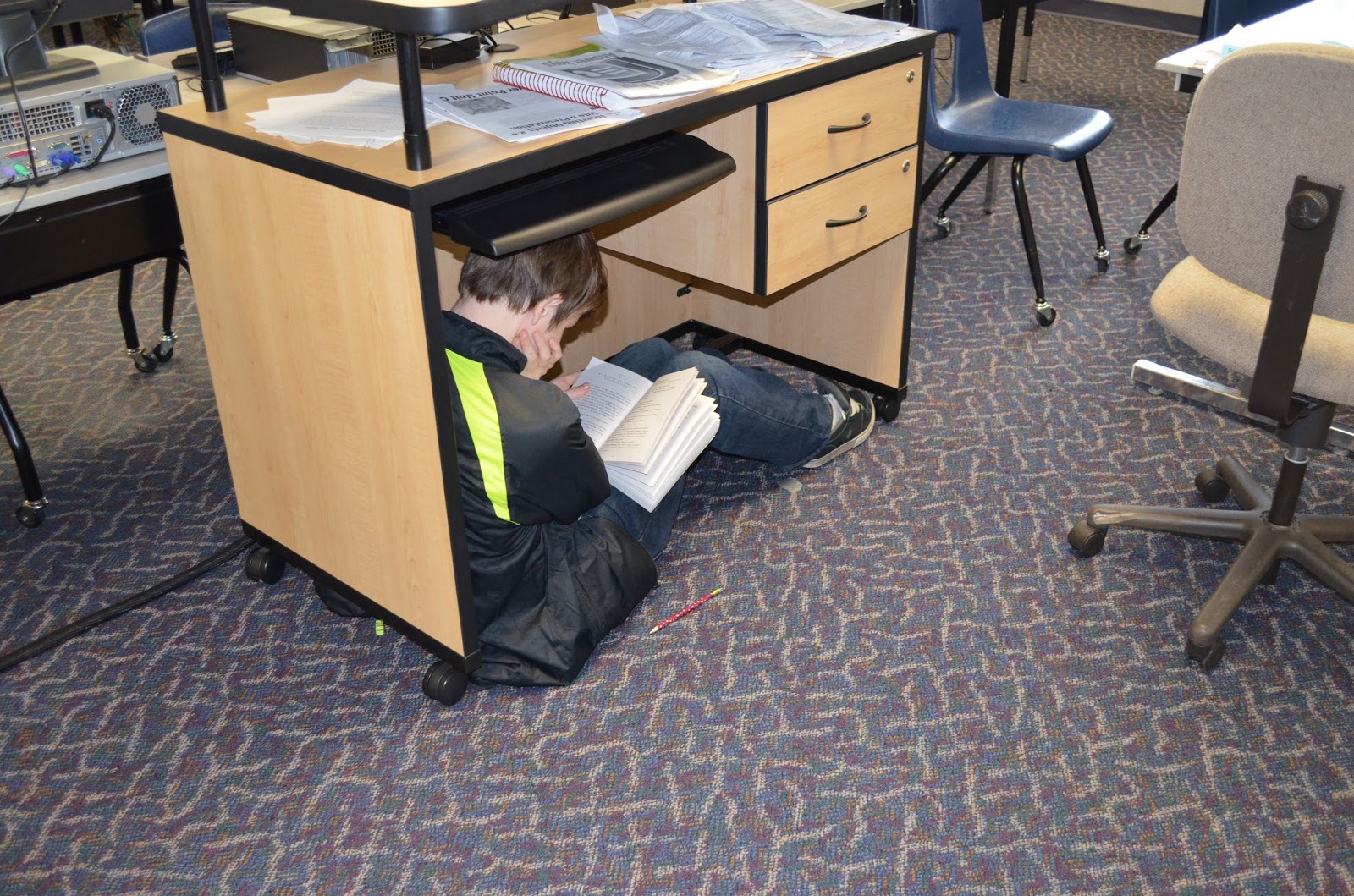
One of the most coveted spot is shown here below the teacher table.  We require the students to spread out throughout the room to minimize distractions.


(The names I used are not actual student names.)

I've heard from many of you this year.  I had mentioned publishing a newsletter for the use of Daily Five and CAFE Menu with middle school students.  However, I am beginning to think that a blog is a much better way to communicate with teachers.  It will allow interaction between us through comments.  I would love to hear about your experience with Daily Five.  I will share what I hear in furture posts.


Monday, May 20, 2013

Year-End Review


Here are some of my favorite photos from Reading Essentials Class 2013.  This is a reading intervention for middle school students.  These students are reading or conferencing about their reading.


The students are allowed to pick a spot for reading. The guidelines are to find a comfy spot where they are not distracted by computers or other students.  My classroom is less than ideal.  It is the computer lab so comfy spots are hard to come by.  My students do not use the computers-strictly reading during Read to Self or conferencing with an adult.


 The students have favorite  spots.  A couple of them always pick the area under the computer teacher table.

The above photo shows a student conferencing.  The key to Reading Essentials Class is found in these pictures.  Read, read, read, and then talk about what you are reading with an adult.  The students read out loud for the adult.  Then together they pick a goal off the CAFE menu to work on until they conference again.  Each conference always begins with assessing how much progress they have made to their goal.

I am currently reviewing the data from the students served this year.  This week of May is when all students are given a test of fluency and comprehension.  This is our universal screener.  I also use it to  identify students in need of interventions and then to  track their progress.  I'll post next week on this year's results.

I use the data to identify students , and I also use teacher recommendations and parent requests.  No data seems perfect for identifying reading difficulties.  It always has to be used with person-to-person observations.  Classroom teachers are so important to my program because they almost always have such a good idea as to why a student is struggling.


Monday, December 10, 2012

Conferencing with Middle School Students


Conferencing with middle school students


One-on-one conferences are one of the pillars of Reading Essentials Class.  Reading Essentials is a reading intervention class at our middle school.  Each day the other teacher and I sit and conference with students.  The focus of the conference is identifying areas of strengths and weakness in the student’s oral reading as well as assessing their comprehension.  Together with the student, we set goals for the student’s read to self time for the upcoming week.
 Because there are two teachers and student numbers around 10 per class, we are able to conference about one time a week for each student.  Each conference lasts between 10 – 15 minutes.
Oral Reading Assessment   We monitor the students’ fluency, decoding, and expression by hearing them read.  The students use the book they are currently reading during read to self time.  We then discuss our observations with the students.  This reminds them the important aspects of oral reading and they can try to implement suggestions during the following week.  Each conference begins with looking at the goal from the previous conference and discussing the progress being made toward the goal.
We use the CAFÉ Menu ® to align the goals with their students’ areas of difficulty.   The areas are comprehension, fluency, accuracy (decoding) and expand vocabulary.  I use expand vocabulary when the student is doing well with all other areas.  Reading Essentials is a reading intervention and most of the students struggle in comprehension, fluency or accuracy.
Student Accountability   The student conference always puts accountability into Read to Self because we monitor the books and pages read by the students.  We record the page number(s) that we heard the student read.  Sometimes their goal for the week is a set number of pages to be read daily.  For some of these students, daily consistent reading is new to them.  Even sticking with one book can be difficult for some.  We discourage jumping from one book to another although if a student really doesn’t like a book, we allow them to make another choice. 
Comprehension   After listening to a student read, we then assess their comprehension.  We may ask them to retell the passage in their own words or ask them questions based on the reading.  If we determine that they are struggling with comprehension, we take out our CAFÉ Menu ® sheet, and look at the comprehension strategies.  We always begin with Check for Understanding.  I set the frequently of the checking for understanding on how much difficulty the student is having.  I may have them stop and check for understanding every page or every paragraph if needed.
Many students complain about conferencing and state that they do so much better reading silently.  I encourage them by saying that most people read better silently but that it is important for me to hear them read so we can accurately set goals and help them improve.
I have found no better way for me to help students with reading difficulties.  Our conferences make it very clear where their difficulties are and the one-on-one attention is a real personalization of education.  

Monday, December 3, 2012

Daily 5 ® for Middle School Newsletter?


The school year is well underway and our Reading Essentials Class is going well.  I'm in my second 6-week session now.  I am learning so much as we are in our third year of using the Daily 5 ® format for middle school.

I have heard from many teachers across the United States who are attempting to use Daily 5 ® at the middle school level as well.  I believe we can be a resource for each other.

I have quite a list of teachers who have emailed me with questions.  As I try to think of the best way to answer the questions, I think we can be a support system for each other.

I am going to start producing a newsletter addressing the specific issues we face as middle school teachers.  Are you interested in getting on my newsletter list?  If so, please let me know and I'll add you to the list.

The first edition will come out right after Christmas.  Things are just too crazy between now and then to even thinking of adding anything else to my plate.  Do you feel the same way?


Friday, October 26, 2012

Taylor Swift Webcast

Scholastic, Inc. produced a webcast this week that features Taylor Swift.  She is talking about reading and the influence reading has had on her life and songwriting.

The program uses the format of a talk show with Trey Morgan, national radio personality,  as the moderator.

The program was 'hip' and geared for middle school students.  Swift had some great advice for surviving middle school.

I loved their motto-RED which is the name of Taylor Swift's new CD.

In this program they say that RED stands for Read Every Day!

I think this correlates well to Read to Self.  We may rename our Read to Self to Read Every Day.

The 37 minute presentation is available for no cost at http://taylorswiftwebcast.scholastic.com/.


Sunday, October 7, 2012

Daily 5 as a Reading Intervention

I received an interesting email from a teacher who is facing a new challenge.   The note said,

I have just accepted a position as a teacher for middle school reading intervention.  This is new to the school so I will be building the program from scratch.  As of right now they will not provide me with a specific intervention program to follow, but want me to incorporate curriculum from other classes while teaching specific reading methods.  I am at a bit of a loss as to where to start.


I have been in that same situation.  Three  years ago I was working as a literacy coach in a middle school.  The school was in the beginning stages of an RTI program.  AIMSWEB was used as a universal screener.  We knew how all the students were reading and which ones were above our benchmark.  But there was no intervention to help the struggling readers.

Kelly asked  

I was wondering if your use of Daily 5 and Cafe could be incorporated into a "homemade" intervention program.  I will be working specifically with at risk readers with specific difficulties in fluency, comprehension, etc.

My answer is yes, yes yes!

My story continues-I couldn't help myself-I said I wanted to design an intervention.  I did just that.  Our elementary schools were in the process of beginning a Daily 5 program.  Plus I had just read the The Book Whisperer.  It was a perfect storm and a longer story than I want to post right now.

 If you have specific questions about using Daily 5 for a reading intervention, I would be glad to answer them.  I've developed many materials that I use in class.  I'll share them too.


Friday, September 28, 2012

Ten Hours of Reading

Can you read for ten hours?

  I asked my students that question today.  They overwhelming felt that they could never read for ten hours.

So I challenged them.  My Reading Essentials Class has 20 minutes of Read to Self every day.  Twenty minutes of silent reading every day.  Five days a week for the six weeks of this middle school exploratory class.

That equals 100 minutes per week.

Read 20 minutes a day times the six weeks of the class= 600 minutes of reading.

600 minutes is 10 hours.

Would you be better at playing sports if you practiced for 10 extra hours?
Would you be better at your musical instrument if you practiced for 10 extra hours?
Everyone knew that 10 extra hours of practice would make you better at sports or music.

You will be better at reading if you practice for 10 extra hours.

I explained that Reading Essentials is a class with laser-focus on reading.  We use every minute to help improve our reading.

I even guarantee results.  I've never had a student who took advantage of the time we give them to practice and takes to heart our goal setting in conferences that didn't improve their reading skills.  I've had students who didn't improve but they also used Read to Self for goofing around or day dreaming. 

How many classes give you a guarantee?  I'm confident of this because I have seen it work.  Over and over students improve with laser focus on improvement.

What fun it is to see this growth in my students.